Chuck
A Dog's Way HomeChuck, whom Bella recognizes as the hat-man, is an animal-control officer whose contested designation of her as a pit bull shapes the conflict between her family and Denver Animal Control. He treats that classification as grounds for increasingly consequential enforcement, even as another officer disputes it and Bella’s behavior challenges the image of danger he applies to her.
Identity and Role
Chuck appears in the story as an officer with practical authority to seize dogs and enforce Denver’s rules. He travels in an animal-control truck carrying crates, approaches Bella with a catch pole, and invokes the city’s authority when attempting to take her. To Bella, who interprets human actions through loyalty to Lucas, he becomes a recognizable threat to her return to her family. The narration’s recurring identification of him as the hat-man gives his appearances a continuity that precedes her full understanding of his role.
His work is presented through more than his own assertions. At the shelter, another animal-control employee describes a recurring conflict: whenever Chuck’s group brings in a dog classified as a pit bull, she challenges the decision. She says Chuck and two colleagues certify more dogs as pits than the other officers combined. Chuck answers that experience has taught them what can happen when a child is bitten. The exchange establishes a stated safety rationale for his approach, while also revealing an internal dispute over how that rationale is applied.
Classification and the Shelter Dispute
Chuck’s central decision is to identify Bella as a pit bull. When Lucas produces a letter, Chuck maintains that the breed assessment stands. In another encounter, Bella takes a treat he has dropped. Chuck uses that response to argue that she cannot qualify as a therapy dog, because, in his view, a therapy dog should be able to ignore food on the ground. The incident shows how he makes a behavioral test serve as evidence in a broader disagreement about Bella’s status. Lucas objects to Chuck feeding her without permission, but the treat also demonstrates how Bella’s immediate response can differ from the disciplined conduct Chuck says the designation requires.
At the shelter, Chuck says that he, Glenn, and Alberto have certified Bella as a pit bull. The other officer points out that Alberto is away; Chuck replies that he sent Alberto a photograph and received an affidavit. She objects to the procedure and says she will file an objection. Chuck insists that he is doing his job and directs that Bella receive a microchip so the city can identify her if she is picked up again. His reference to a two-strike rule makes the practical consequence plain: a future seizure could place her at risk of being held and destroyed under the policy described to Lucas.
The disagreement is not presented as a simple division between an official system and a single dissenter. The shelter employee says most officers care deeply about animal welfare, but identifies Chuck as an exception in her own assessment and alleges that he has colleagues who cover for one another. She also warns Lucas that appeals go through the courts and judges tend to defer to animal-control officers. These are her claims, not an independent account of every officer or court. Within the scene, however, they explain why a disputed assessment carries more weight than a disagreement between coworkers: the classification is attached to procedures that can constrain Bella’s future.
Seizure and Escalation
Chuck’s enforcement moves beyond the shelter’s assessment. When he encounters Lucas and Bella, he states that he is seizing her under Denver’s authority. Lucas kneels beside Bella and handles her collar, while Chuck warns that releasing her and then being caught with her off leash could lead to her being darted. Chuck also calls for police support, presenting the situation as an owner resisting a legal order and asking the officers to arrest Lucas for noncompliance. One of the police officers questions whether Bella is a pit bull; Chuck answers that three animal-control officers have certified her.
The exchange makes the gap between official classification and visible conduct central to the confrontation. The police officer’s question does not settle the matter, and Chuck’s response rests on the certification he has repeatedly defended. For Lucas, the risk is not limited to losing Bella in that moment: the shelter employee has already explained that a subsequent pickup within Denver could trigger the two-strike consequence. Chuck’s actions therefore turn a breed judgment into a continuing threat of separation.
Return and Narrative Significance
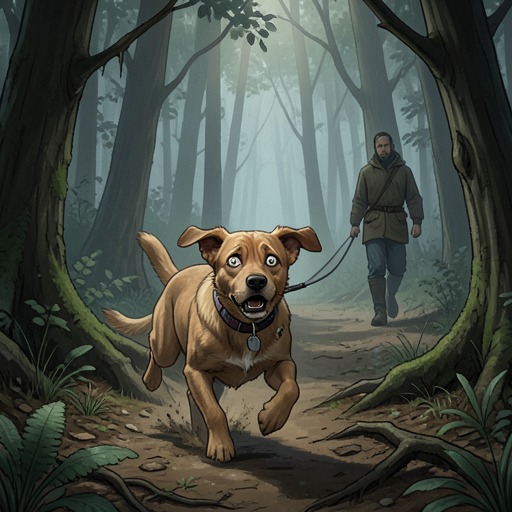
After Bella returns to her former neighborhood, she encounters Chuck again beside his truck, which carries dog crates. He approaches with the same catch pole and offers a treat. Bella recognizes him, does not approach, and runs away. The reversal is significant because the treat that once drew her close no longer overrides what she has learned about his role in keeping her from Lucas. The narrative gives the encounter through Bella’s understanding, so her judgment of Chuck as dangerous reflects the lived consequence of his earlier attempts to seize her, rather than a neutral account of his character.
Chuck later appears with police outside the VA hospital, where Bella’s friends and family have gathered around her. He declares that he has come for the dog. During the ensuing dispute, he invokes Denver city ordinance 8-55 as the authority to confiscate her, while another man tells him that he is worsening the situation. The recurrence of police, the truck, and a legal claim echoes the earlier street seizure, but the hospital setting places Chuck’s enforcement in conflict with the group’s effort to protect Bella.
Chuck’s narrative importance lies in how consistently he treats an institutional category as actionable fact. The book does not erase his stated concern about bite risk, but sets it beside challenges from a colleague, a police officer’s doubt, and Bella’s conduct as she seeks safety and companionship. His repeated reliance on certification and ordinance contrasts with the particular animal before him. Through that contrast, Chuck becomes the human face of a system in which a contested label can determine where Bella may go, whether she can remain with Lucas, and what a future seizure might mean.